The Crossings
This family emigrated twice, in two waves half a century apart, to opposite sides of the world. The first went to America. The second went to Australia. Both left from the same three towns.
Four crossings, four ships, and a column nobody had read
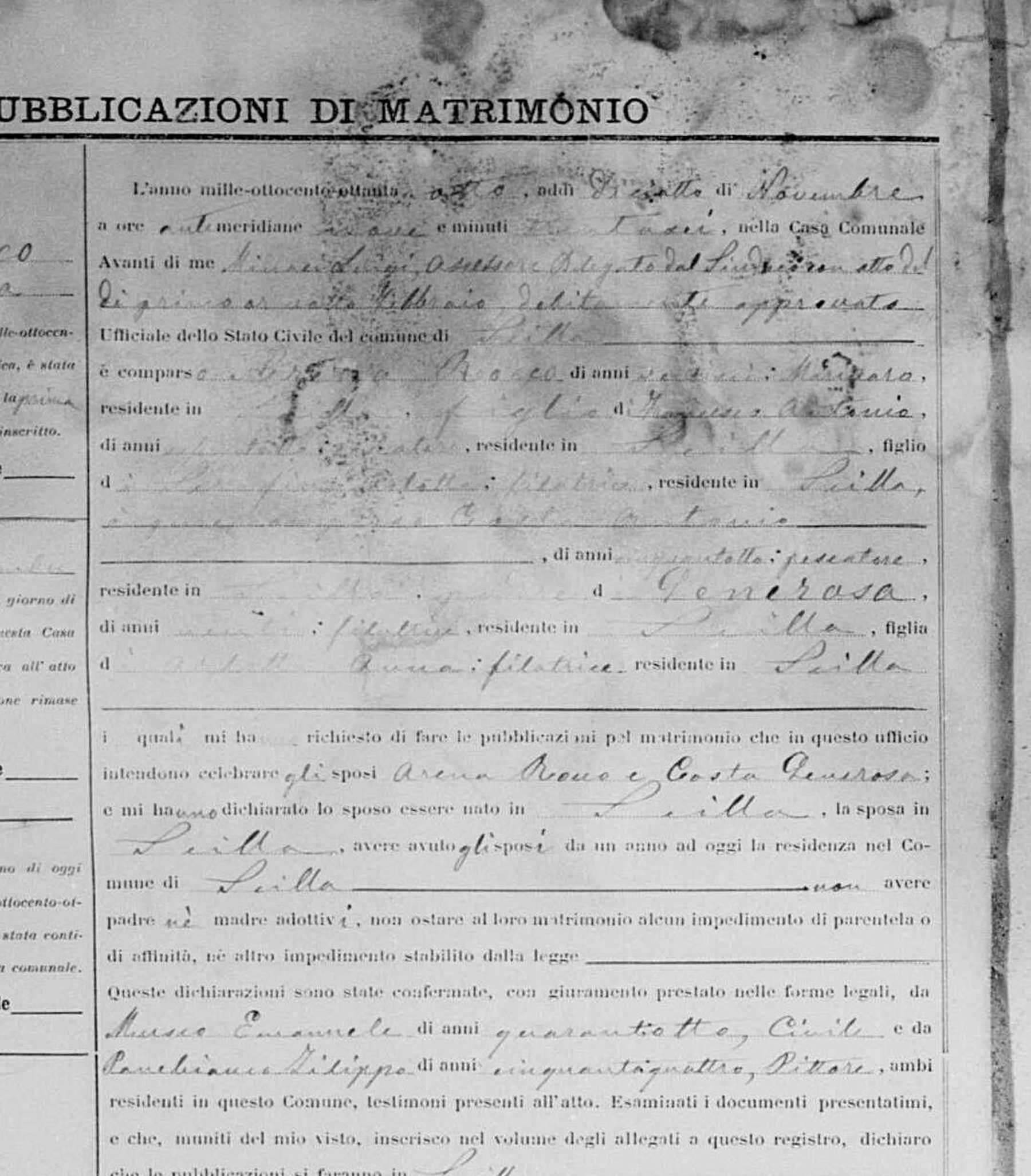
This site has carried Rocco Arena 's four Atlantic crossings as a list with one ship named and one year marked probable. All four are indexed, with the vessel, the port and a birth year — 1861 on every one. Four clerks over twenty-one years, agreeing with a birth act of 20 December 1861 that none of them had seen.
The 1900 line says something the archive did not know: in March 1900 he was already an American citizen and living at Scilla. Three months later the census finds him in Manhattan with a wife and two children. He was going back and forth with a passport, not emigrating.
The column nobody had read
A passenger manifest has two relation fields — who you left behind at the departure port, and who you were going to at the arrival port. This archive had never used them. The 1913 line reads:
Departure port relation (WIFE): Corta
Generosa
Arrival port relation (NEPHEW): Antonio Arena
So Generosa Costa — her surname mangled to Corta — stayed at Messina, and Rocco sailed to a nephew in New York. A nephew of that name would be a son of Giovanni or Giuseppe Arena, and the family tree has no such person. Recorded as a lead: Rocco's own son Antonio was born in Manhattan in 1896 and would have been seventeen, and a clerk could have written nephew for son.
Reading the neighbours is the technique. It is also what exposed the Clementina error below: the line above hers named a father and a residence four hundred kilometres from this family. A manifest line on its own is a name; a manifest line with its neighbours is a household.
The lodger in the 1900 census is Rocco's brother
Household 325 of Election District 5, Manhattan, June 1900, has nine people in it: Rocco Arena and Generosa, their two children, and five lodgers. One of the five is John Arena, 42.
Read on its own, that is a man with a common surname boarding with strangers. Read against the Scilla marriage act of 1885, it is not. Giovanni Arena is Rocco's own brother — born 30 April 1854, married Concetta Russo in October 1885 — and he landed at Ellis Island on 23 May 1899, aged forty-five, travelling with Rocco's six-year-old daughter Anna, who is entered on the line above his as his niece. A brother who arrives in May 1899 bringing his niece to her father, and who is still under that roof thirteen months later, is not a boarder.
The age is four years low — born April 1854 he was forty-six, not forty-two — which is the same size and direction of error as the thirty-three in his son's birth act of 1892.
Stated as an inference. The census gives no relationship for lodgers. Nothing in the record itself says brother; what says it is the birth act, the marriage act and the manifest, read together.
One parish, one colony
The New York Roman Catholic index holds eighty-four Arena baptisms, and at Our Lady of Loretto alone the Arena fathers are Rocco, Giovanni, Rosario, Michele, Felice, Pietro, Mariano, Ignazio, Angelo, Vincenzo, Giacomo and Aurelio. That is not a family; it is a town in exile, christening its children in one Manhattan church.
Three of Rocco's own are there — Antonio 1896, Serafina 1898, Clementina 1900. And two that may be his brother's: an Angelica Arena, born and baptised 1900, father entered as Giovannie, and a Michela Arena, born 1908, father Giovanni. Giovanni Arena landed in May 1899 and was under Rocco's roof in June 1900. If either child is his, he did not go straight home — and the tree has neither. Recorded as a lead: the index gives no mother, and there are several Giovanni Arena in that register.
What is locked, and why it matters. The index rows are free; the transcripts — which carry the mother's name and the godparents — sit in the Catholic Heritage Archive, above this subscription. Godparents are the prize. In a southern Italian emigrant parish they are almost always kin, and they would settle at one stroke whether the Giovanni Arena of 1900 is Rocco's brother, and who the Arlotta in that household really were.
Two searches that came back wrong, and one that came back empty
Clementina Arena's 1921 crossing is not found — and this site has now been wrong about that in both directions on the same day. It is worth setting out in order, because the mistake is more instructive than the record would have been.
First this page said the crossing was not found: the Statue of Liberty index returns only a Clemente Arena — male, twenty-six, out of Messina on the San Giovanni. That was right.
Then it was “corrected”, on the strength of a FindMyPast record this archive had held for months — Clementina Arena, Ellis Island, 1921. That correction was wrong, and the record had never been opened. Reading the neighbouring lines settles it: the same manifest — the Giuseppe Verdi out of Naples — carries at line 1 a Rosa Arena, twenty-seven, resident at Vittoria, in the province of Ragusa, whose father is named at line 2 as Giovanni; and line 3, Clementina, is entered as Rosa's sister.
Vittoria is four hundred kilometres from Scilla and at the far end of Sicily from Piedimonte Etneo. These are simply other people. So: two indexes, three women called Clementina or Clemente Arena, and none of them hers.
The lesson this archive keeps relearning. A name and a year are not an identification. The original record was entered on nothing more than that, and it survived for months because it looked like a find rather than a guess. A negative that has been tested is worth more than a positive that has not.
And his children name his parents back
Three free index rows settle it beyond argument. Rocco Arlotta's marriage act of June 1900 gives his father as Antonio, his mother as Nicolina Caratozzola, and his wife's mother as Peppina Fusto. His children, baptised at the Arena's own parish, are:
First daughter for the paternal grandmother, first son for the paternal grandfather, second daughter for the maternal grandmother. Three for three. The man who lodged with Rocco Arena, the man who married Antonietta Tavani that June, and the man baptising children at Our Lady of Loretto are one man.
Two other Arlotta households share that register — a Francesco with six children between 1901 and 1911, and a Giovanni with a daughter in 1896. The Arlotta were in New York in numbers, like the Arena.
Two absences that say something
Rocco Arena has no naturalisation petition in this collection, though he is entered as a US Citizen on the manifests of both 1900 and 1913. The set begins too late for him; his declaration is in an earlier New York court series, which means the National Archives rather than a subscription.
And Antonio Arena, born in Manhattan on 4 October 1896, is not in the New York draft registrations of 1917–18. He was an American citizen and should have been. Put that beside Rocco's missing 1910 census entry and the 1913 manifest on which he sails without Generosa, and it reads one way: the family had gone back to Italy, and the children with them. The boy born in Manhattan was living at Scilla when his own country called him up.
The Arlotta lodger, identified
The census puts a Rocco Arlotta, 23 in the household, and that Arlotta is one of the five supports for this site's correction of the Arena parentage. He was, until now, an age and a surname. Ellis Island held two Rocco Arlotta of Scilla — 1898 and 1904 — and the 1898 man is entered at thirty-two, nine years too old.
FindMyPast has settled it. The United States Marriages index gives Rocco Arlotta, twenty-two, born 1878, marrying Antonietta Tavani in Manhattan on 4 June 1900 — the same month the census found him under Rocco Arena's roof. His father was Antonio Arlotta, his mother Nicolina Caratozzola.
Two things follow. The 1898 arrival is a third man, and the lodger's own crossing is still unfound. And because his father is Antonio and not the Giovanni Arlotta who was Serafina's father, he is not her nephew — a cousin is likelier, and untested.
And he stayed. A Rocco Arlotta baptises children at Our Lady of Loretto in 1905 and 1908 — the Arena's own parish, where Serafina and Clementina were christened. He was not a stranger boarding with strangers; he was part of the same Scilla colony in the same few streets.
Lorenzo Costa, 24, is not in the index at all. Six hundred and seventy-four Lorenzo Costa are indexed across every American port and not one gives Scilla as a last residence. Nor is there an Antonino Arena of Scilla among seven hundred and twenty-seven of that name.
The first wave — America, 1894–1926
Out of Briatico and Scilla, through Naples, Palermo and Messina, into New York and New Orleans. This is the classic Italian emigration and this family was fully part of it. Three of them — Fillipo Melluso , Domenica Anile and Concetta Anile — came off the same ship at New York on 2 August 1906.
| Who | Born | From | Left | Arrived | Date |
|---|---|---|---|---|---|
| Anna Arena | 1893 | Scilla, Reggio Calabria | — | — | 1894 |
| Generosa Costa | Italy | — | — | 1894 | |
| Domenica Anile | 1880 | Briatico, Vibo Valentia, Calabria | — | New York, New York | 2 August 1906 |
| Fillipo Melluso | 1903 | Briatico, Vibo Valentia, Calabria | Naples, Campania | New York, New York | 2 August 1906 |
| Concetta Anile | 1888 | Briatico, Vibo Valentia, Calabria | Naples, Campania | New York, New York | 2 August 1906 |
| Michele Donato | 1851 | Scilla, Reggio Calabria | Palermo, Sicily | New Orleans, Louisiana | 11 March 1908 |
| Rocco Arena | 1861 | Scilla, Reggio Calabria | Messina, Sicily | New York, New York | 12 September 1913 |
| Michele Mazza | 1909 | Catania, Sicily | Italy | Fremantle, Western Australia | 21 April 1925 |
| Maria Rosa Melluso | 1907 | New York, New York | Palermo, Sicily | New York, New York | 30 June 1926 |
| Salvatore Mazza | Briatico, Vibo Valentia, Calabria | Genoa, Liguria | Fremantle, Western Australia |
One of them went home again. Maria Rosa Melluso was born in New York on 14 October 1907, left it as a child in 1914, came back through the port on 30 June 1926 — and died at Briatico in 1994. An American citizen by birth who spent almost her whole life in a Calabrian coastal town, and whose granddaughter's children are Australian.
An age is a birth year, and this family's birth years keep being wrong
Two men this archive had failed to find in Italian registers left records in America. That turned out to be the way in, because an arrival manifest records an age — and an age converts to a birth year, which is precisely the thing the family tree keeps getting wrong. The Statue of Liberty Foundation's Arrival Records Collection is free, needs no account for the index, and covers New Orleans as well as Ellis Island.
The Liguria, 22 February 1908 — the image, and the oldest question in this archive
The index gave Michele Donato 's age and nothing else. The manifest page itself gives five more things, and one of them closes a question that has been open since the first week.
S.S. Liguria, sailing from Palermo, 22 February 1908 — List or Manifest of Alien Passengers for the United States
nearest relative: "Wife Maria Sofi, Via Grotte, Scilla" · destination Quincy, Florida
nearest relative: "Father Antonino Polistena and mother Giovanna Romano, Scilla" · destination Quincy, Florida
They are on consecutive lines. Michele Donato and Giovanni Polistena crossed the Atlantic together in February 1908, bound for the same town in Florida — and about eight years later Giovanni married Michele's daughter Nunnziata Donato .
Romano, not Pontillo — settled
The family tree gives Giovanni Polistena's mother as Giovanna Pontillo. Act 206 of 1883 says Giovanna Romano. This archive has carried that as an open conflict for days, noting each time that Pontillo is a real Scilla surname and the tree might yet be right.
It is not. A United States immigration manifest, filled in from Giovanni's own statement twenty-five years after his birth and half a world from Scilla, names his mother Giovanna Romano. Two independent records, two continents, one answer.
The father's name moves a little too, and towards the tree. The 1883 act calls him Camillo Antonio Polistena; the tree calls him Antonio; his son in 1908 calls him Antonino. All three are the same man, and the tree's version was never the problem.
Louisiana, New Orleans Passenger Lists, 1820–1945
(NARA T905), roll 19, image 763 — FamilySearch 3:1:33S7-95CH-L8S. The page was
read by stitching its DeepZoom tiles at native resolution, 4048 × 4097.
Michele Donato: two independent witnesses to 1856
The tree puts his birth at Scilla in 1851. His daughter's birth act makes him 36 in July 1892. This manifest makes him 52 in 1908. Both give about 1856, and neither supports 1851 — and the manifest image above makes a third — which is exactly why the 1851 index had no Donato in it. It is the only New Orleans arrival among forty-nine Michele Donato records in the collection, and it matches the port and the year the tree already claimed.
It also settles a doubt this archive raised three days ago. Having found no Donato in the Scilla birth indexes for 1851, 1856 or 1859, the working hypothesis was that the surname arrived at Scilla late and Michele was born elsewhere. Fifteen Donato gave Scilla as their last residence at Ellis Island between 1893 and 1921. They were unquestionably a Scilla family. Where Michele was born is still open — but "the Donato are not really of Scilla" is not the answer.
Rocco Arena: the conflict resolves, against the tree's parents rather than its dates
This archive has spent three days on a single contradiction. The tree makes Rocco Arena — born 1861 — the son of Orazio Arena and Giovana Zirilli. Act 228 of the 1861 Scilla register says Francesco Antonio Arena, marinaro, and Serafina Arlotta, and 1861 holds exactly one Rocco Arena. Either the parents were wrong or the year was.
Three independent strands now point the same way.
The tree's year is right. What is almost certainly wrong is the parentage — and Orazio Arena and Giovanna Zirilli, who are documented twice over as a real Scilla couple, are simply a different household that the tree attached him to.
Added later the same day, and it cuts the other way. The 1858 Tavola was opened looking for Giovanni Arena. He is not in it — but act 60 of 1858 is a Rocco Arena, born 23 April, son of Santo Arena and Giovanna Gioffrè. The claim above is still literally true — 1861 holds exactly one Rocco Arena — but the useful version of it, that there is only one Rocco Arena of about the right age to choose from, is not true any more.
The arithmetic still favours 1861. A man born 20 December 1861 is 38 in March 1900; the 1858 boy would be 41; the manifest says 39. And the tree, independently, says 1861. But "three strands agree" was a cleaner sentence yesterday than it is today, and the archive would rather say so than leave the cleaner sentence standing.
One honest caveat. Manifest ages are approximate and the indexed "year of birth" is derived from the age, not copied from a document. A man born on 20 December 1861 would be 38 in March 1900, not 39 — so this is a year loose. It does not pin the date. What it does do is rule out the alternative the archive was entertaining, that Rocco's birth was years away from 1861 and hiding in another volume. The chart still draws the tree as it stands, because this archive does not rewrite what it was given on the balance of evidence — it records the balance instead.
Four crossings, and a Polistena on the last one
Rocco Arena crossed the Atlantic at least four times, and the archive can now put a ship against every one of them:
The 1892 record dates the tree's bare "1892" to the day, names the ship and the port, and adds a fourth independent statement that this man worked the water — Seaman, after marinaro in 1893, Sailor in 1900, and marinaro for his father and grandfather in the marriage act of 1851.
The 1894 one is a candidate, not a finding. The age is right, the year is right — and it is the year the family tree assigns a crossing to Anna Arena and Generosa Costa, so it may be where that stray date came from, attached to the wrong people. But the occupation is Tailor, where every other record of this man says he worked the water. Passenger-list trades are loosely taken and Arena is a common name. It is not merged.
That last one confirms the family tree twice and corrects it once. The tree gives him a departure from Messina — right — and an arrival on 12 September 1913. It was the 11th.
And he was not travelling alone. Four frames away on the same manifest — T715-2174, frame 292, line 19 — is Rocco Polistena, 44, of Scilla. An Arena and a Polistena came off the same ship on the same day in 1913. A generation later Anna Arena 's son Rocco married Angela Polistena .
Who took a six-year-old across the Atlantic
Anna Arena crossed on the Archimede on 23 May 1899, aged six. On the same film, the same frame, the line immediately above hers, is Giavanni Arena, 45, married, of Scilla. She travelled with him, not with her father — who arrived ten months later, and as an American citizen. Her brother Antonio had been born in New York in 1895.
So the order runs backwards from what the tree implies. Rocco Arena was in America first and for long enough to naturalise; his six-year-old daughter was brought over in 1899 by another Arena; and the family later went home to Scilla, where Anna married Giuseppe Arena and their son Rocco was born in 1924.
The image settles who he was, and it does so twice. Line 4 of the manifest does not begin with a surname. It begins with the word "Niece" — "Niece, Anna Arena, 6, occupation none". And in the column asking whether the passenger goes to join a relative, line 3 reads "brother Rocco, N. York, Mulberry St".
Giovanni Arena is Rocco Arena's brother — a sibling the family tree does not have — and Rocco was living on Mulberry Street in May 1899. The document states both relationships outright; nothing here is inferred.
His age, 45, matches the Arena Giovanni born at Scilla on 20 April 1854 to the day. One loose end: that act names the mother Rosa Arlotta where Rocco's names her Serafina Arlotta. The father in both is written "Ant.º", exactly as the 1852 act writes Francesco Antonio.
Five lines of one manifest: the Luisiana, 2 August 1906
The tree records three people arriving at New York on 2 August 1906 and names no ship. It was the Luisiana, and they were not three people but five, on five consecutive lines of one page:
Domenica Anile's birth is given in the tree as 20 February 1880, which makes her twenty-six on the day — and the manifest says twenty-six. The three-year-old on the next line is her son by Domenico Melluso, and the transcriber ran the child's surname into his mother's, which is how a Filippo Melluso came to be indexed as Foloppo Melluso Anile.
Two people on that page are not in the family tree at all — Teresa Anile, 20, and the one-year-old Francesco. A family of five crossed; the tree remembers three.
There is a second Filippo Melluso of Briatico on the same ship, aged thirteen, four lines and two frames earlier. He is not the tree's man — the tree's is the three-year-old — and he is recorded here so that no one later merges them on the strength of a name and a date.
The image has now been read, and it names the man they were going to. The five lines are braced together and the going to join column gives one address for all of them: "Domenico Melluso, 2173 First Ave, N.Y." The relationship words across the group are brother (or mother), husband, father, father, cousin.
So Domenica Anile was sailing to her husband — which the tree already says, and the manifest now confirms — and the two small boys to their father. The name column carries only two written surnames, Anile against the women and Melluso against the children, with ditto braces. That is exactly how the index came to hand a Melluso child an Anile surname. The one-year-old on line 29, indexed as "Francesco Anile", is Francesco Melluso — Domenica's younger son, and not in the family tree.
And the address places them. 2173 First Avenue is East Harlem, not Little Italy. The Briatico people were settling a mile and a half uptown from where the Scilla Arena were living on Mulberry Street — two branches of one family in two different Italian New Yorks, seven years apart.
One caveat. The exact line-by-line alignment of the relationship column is not certain, because the brace spans several rows. The destination and the husband are.
The Polistena and the Donato were already together in 1903
On the Sicilian Prince, 12 August 1903, line 1 is Annunziata Polistena, 17, and line 2 is Giovanni Donato, 16 — both of Scilla, side by side on the same page. Further down the same manifest, lines 28 and 29, are Giuseppe Polistena, 30, and Maria Polistena, 27, a married couple.
Giovanni Polistena did not marry Nunziata Donato until about 1916. Thirteen years earlier two teenagers from those families were crossing the Atlantic on consecutive lines of one ship's manifest. And in 1901 on the Neustria, Pasquale Donato and Lorenjo Costa of Scilla are two lines apart — Costa being Generosa Costa 's surname. These were not three families who happened to marry; they were neighbours who moved together.
| Name | Arrived | Port | Age | → born | Ship | Line |
|---|---|---|---|---|---|---|
| Rocco Arena | 21 March 1900 | Ellis Island, New York | 39 | 1861 | Trave | 0027 · 108/180 |
| Anna Arena | 23 May 1899 | Ellis Island, New York | 6 | 1893 | Archimede | 0004 · 65/220 |
| Giovanni Arena | 23 May 1899 | Ellis Island, New York | 45 | 1854 | Archimede | 0003 · 65/220 |
| Michele Donato | 1908 | New Orleans, Louisiana | 52 | 1856 | Liguria | 0015 · T905 roll 19/763 |
| Giuseppe Polistena | 12 August 1903 | Ellis Island, New York | 30 | 1873 | Sicilian Prince | 0028 · 382/166 |
| Maria Polistena | 12 August 1903 | Ellis Island, New York | 27 | 1876 | Sicilian Prince | 0029 · 382/166 |
| Annunziata Polistena | 12 August 1903 | Ellis Island, New York | 17 | 1886 | Sicilian Prince | 0001 · 382/164 |
| Giovanni Donato | 12 August 1903 | Ellis Island, New York | 16 | 1887 | Sicilian Prince | 0002 · 382/164 |
| Pasquale Donato | 13 March 1901 | Ellis Island, New York | 41 | 1860 | Neustria | 0028 · T715-0175/195 |
| Lorenjo Costa | 13 March 1901 | Ellis Island, New York | 26 | 1875 | Neustria | 0030 · T715-0175/195 |
| Domenica Anile | 2 August 1906 | Ellis Island, New York | 26 | 1880 | Luisiana | 0027 · 748/315 |
| Fillipo Melluso | 2 August 1906 | Ellis Island, New York | 3 | 1903 | Luisiana | 0028 · 748/315 |
| Concetta Anile | 2 August 1906 | Ellis Island, New York | 21 | 1885 | Luisiana | 0026 · 748/315 |
| Teresa Anile | 2 August 1906 | Ellis Island, New York | 20 | 1886 | Luisiana | 0025 · 748/315 |
| Francesco Melluso | 2 August 1906 | Ellis Island, New York | 1 | 1905 | Luisiana | 0029 · 748/315 |
| Filippo Melluso | 2 August 1906 | Ellis Island, New York | 13 | 1893 | Luisiana | 0009 · 748/313 |
| Giovanni Polistena | 11 March 1908 | New Orleans, Louisiana | 24 | 1883 | Liguria | 0016 · T905 roll 19/763 |
| Rocco Arena | 11 September 1913 | Ellis Island, New York | 52 | 1861 | San Guglielmo | 0003 · T715-2174/296 |
| Rocco Arena | 24 May 1892 | New York | 31 | 1861 | Elysia | — · Italians to America Passenger Data File/— |
| Rocco Arena — CANDIDATE | 10 August 1894 | New York | 33 | 1861 | Suevia | — · Italians to America Passenger Data File/— |
| Rocco Arlotta | 16 May 1898 | Ellis Island, New York | 32 | 1866 | Spartan Prince | — · —/— |
| Clemente Arena | 1 April 1921 | Ellis Island, New York | 26 | 1895 | San Giovanni | — · —/— |
| Rocco Arena | 1892 | Ellis Island, New York | 31 | 1861 | Elysia | — · —/— |
| Rocco Arena | 1894 | Ellis Island, New York | 33 | 1861 | Suevia | — · —/— |
| Rocco Arena | 1913 | Ellis Island, New York | 52 | 1861 | San Guglielmo | — · —/— |
Statue of Liberty & Ellis Island Foundation, Arrival Records Collection — New York, Passenger Arrival Lists (Ellis Island), 1892–1925 and Louisiana, New Orleans Passenger Lists, 1820–1945 (NARA T905). Every row carries a FamilySearch ark for the manifest page itself. The Liguria page has now been read in full — see above. The remaining images are still to do.
One line, and a whole Scilla household under a New York roof
A manifest gives you one person at a time. A census sheet gives you everyone in the building. The 1899 manifest sent Giovanni Arena 's brother to Mulberry Street; Mulberry Street is in Ward 6; and here, on sheet 17A, line 16, household 325, is Rocco Arena .
It confirms the family tree on four points at once — the 1892 arrival, Generosa Costa as his wife, Anna as his daughter, and Antonio born in New York — and it adds two things the tree does not have. He had been married ten years, so Rocco Arena and Generosa Costa married in 1890. And he gave his own birth as September 1861, where act 228 of 1861 says 20 December. Census months are self-reported and three months adrift is ordinary; the year agrees, which is the part that was ever in doubt.
The other five names are the finding. Living with them: a Costa, which is Generosa's surname; an Arlotta, which is Rocco's mother's surname; and three more Arena — Domenico 18, John 42 and Rafael 17. This is not a household, it is a piece of Scilla transplanted into one tenement. John Arena, 42, is all but certainly the brother Giovanni who had brought six-year-old Anna over the year before. And Lorenzo Costa, 24, is all but certainly the Lorenjo Costa, 26, of Scilla who came off the Neustria on 13 March 1901, two lines from a Donato.
United States Census, 1900 — Borough of Manhattan,
Election District 5, New York City Ward 6, ED 117, New York County; NARA T623. FamilySearch
1:1:MSJ5-T7D.
Four children born in Manhattan, three of whom the tree never knew
The family tree has Rocco Arena and Generosa Costa going to America and coming home. It does not have what happened in between.
| Name | Born | In the tree? |
|---|---|---|
| Antonio Arena | 4 October 1896 | yes |
| Sarafina Arena | 14 August 1898 | no |
| Clementina Arena | 18 December 1900 | no |
| Antonino Arena | 12 October 1902 | no |
Sarafina Arena, born 14 August 1898, died on 30 January 1900 and was buried the next day, aged seventeen months. That is why she is not in the census taken that June, and it is why nobody remembered her.
And her name is evidence. Act 228 of 1861 gives Rocco Arena's mother as Serafina Arlotta — the parentage this archive spent four days arguing about. In New York in 1898, Rocco named a daughter Serafina. It is not proof, and it is the third separate thing to point the same way: the sibling pair in the register, the Arlotta lodging with them in 1900, and now a dead child's name.
The second wave — Australia, 1949–1961
Every single one of these sailed from Genoa. That is not a coincidence of record-keeping: post-war assisted migration to Australia was run out of the northern ports under the 1951 Italian–Australian migration agreement, and a Calabrian or Sicilian family travelled the length of the country to board.
| Who | Born | From | Left | Arrived | Date |
|---|---|---|---|---|---|
| Sebastiano Mazza | 1920 | Piedimonte Etneo, Catania, Sicily | — | Fremantle, Western Australia | 4 October 1949 |
| Angela Polistena | 1925 | Scilla, Reggio Calabria | Genoa, Liguria | Brisbane, Queensland | 17 June 1949 |
| Antonino Polistena | 1917 | Scilla, Reggio Calabria | Genoa, Liguria | Brisbane, Queensland | 17 June 1949 |
| Michael Antonio Polistena | 1933 | Scilla, Reggio Calabria | Genoa, Liguria | Fremantle, Western Australia | 28 May 1950 |
| Domenica Prostamo | 1928 | Briatico, Vibo Valentia, Calabria | Genoa, Liguria | Fremantle, Western Australia | March 1951 |
| Mariano Cavallaro | 1909 | Mascali, Catania, Sicily | Genoa, Liguria | Fremantle, Western Australia | May 1951 |
| Rocco Arena | 1924 | Scilla, Reggio Calabria | Genoa, Liguria | Brisbane, Queensland | December 1953 |
| Venera Cavallaro | 1916 | Piedimonte Etneo, Catania, Sicily | Genoa, Liguria | Brisbane, Queensland | 6 October 1953 |
| Luciano Cavallaro | 1945 | Catania, Sicily | Genoa, Liguria | Brisbane, Queensland | 6 October 1953 |
| Francessco Prostamo | 1900 | Briatico, Vibo Valentia, Calabria | Genoa, Liguria | Fremantle, Western Australia | 10 October 1957 |
| Francesco Melluso | 1901 | Briatico, Vibo Valentia, Calabria | — | Miami, Florida, USA | 18 June 1961 |
Nine of them now have a ship
The NAA passenger arrivals index, 1898–1972, is arranged by voyage: one item is one ship on one date, and every passenger aboard shares the item number. Searching it by name and date turned nine of these eighteen crossings from a date into a named vessel.
| Who | Date | Ship | From | Arrived | NAA item | Confidence |
|---|---|---|---|---|---|---|
| Michele Mazza | 21 Apr 1925 | Palermo | Messina | Brisbane | 12260784 | documented |
| Angela Cupo | 07 Dec 1937 | Viminale | — | Brisbane, Queensland | 7247867 | documented |
| Sebastiano Mazza | 04 Oct 1949 | Toscana | Genoa | Melbourne | 9243236 | documented |
| Antonino Polistena | 17 Jun 1949 | Surriento | Naples | Australia | 9245788 | documented |
| Carmelo Armanno | 08 May 1949 | Napoli | Naples | Australia | 9245202 | inferred |
| Angela Polistena | 17 Jun 1949 | Surriento | Naples | Australia | 9245788 | inferred |
| Mariano Cavallaro | 13 May 1951 | Ravello | Messina | Brisbane | 30133235 | inferred |
| Venera Cavallaro | 23 Sep 1953 | Surriento | Italy | Fremantle | 30133845 | inferred |
| Luciano Cavallaro | 23 Sep 1953 | Surriento | Italy | Fremantle | 30133845 | inferred |
| Rocco Arena | 27 Dec 1953 | Sydney | Genoa | Fremantle | 32967991 | inferred |
| Francessco Prostamo | 21 Oct 1957 | Roma | Genoa | Brisbane, Queensland | 30132189 | documented |
| Maria Nicotra | 20 Apr 1962 | — | — | Sydney | 5041955 | documented |
Where the index corrects the tree
Michele Mazza — Exact date. Corrects the port of arrival from Fremantle to Brisbane and the port of embarkation from "Italy" to Messina.
Angela Cupo — FROM HER ALIEN PASSENGER DECLARATION, not from the passenger index -- «CRUPI [MAZZA] Angela born 20 December 1900; Maria age 15; Carmela age 8; nationality Italian; travelled per VIMINALE arriving in Brisbane on 7 December 1937». THE ARCHIVE HAD NO CROSSING FOR HER AT ALL and no sense that this family was in Australia before the war. She comes with TWO DAUGHTERS and she comes to BRISBANE, which is where Rosario Mazza is on the electoral roll twenty-two years later.
Sebastiano Mazza — Exact date. Other passengers on the same item disembarked at Fremantle; the index records Sebastiano's port as Melbourne.
Antonino Polistena — Exact date. Indexed as "Antonio". Corrects the port of embarkation from Genoa to Naples.
Carmelo Armanno — No crossing was recorded for him in the tree at all. Identification rests on the name and the period.
Angela Polistena — Not in the index under her own name. Her BROTHER Antonino Polistena is, on the SURRIENTO arriving 17 June 1949 -- the exact date the tree gives for Angela. Brother and sister arriving on the same day arrived on the same ship. The same item also carries an ARENA ANTONINA, which is worth noting: Angela would marry Rocco Arena.
Mariano Cavallaro — The tree gives only the month. Corrects the port of arrival to Brisbane and the embarkation to Messina.
Venera Cavallaro — The dates differ by thirteen days because they are two legs of one voyage: the Surriento made Fremantle on 23 September and Brisbane on 6 October. Travelling with Luciano Cavallaro.
Luciano Cavallaro — Same voyage and same item as Venera Cavallaro.
Rocco Arena — The tree gives only the month. Fremantle on 27 December fits a Brisbane arrival in the first days of 1954.
Francessco Prostamo — Exact date, port and embarkation all agree. The Francesca Prostamo on the same voyage is now IDENTIFIED: she is his daughter, born 1945 at Briatico, aged twelve. The tree records no crossing for her at all -- she travelled with her father. CORRECTED 20 SEPTEMBER -- THE PORT AND DATE IN THIS ROW ARE NOW THE DEBARKATION, NOT THE LANDFALL. The ROMA first touched Australia at FREMANTLE on 10 OCTOBER 1957, which is what the passenger index records and what the tree copied. He did not get off there. NAA: BP25/1, the BRISBANE aliens series, records him and Francesca arriving at BRISBANE on the T/v ROMA on 21 OCTOBER 1957 -- eleven days after the ship's first Australian landfall. The passenger index gives the voyage; the aliens registration gives the man. The family settled in Queensland, which is what the second date says.
Maria Nicotra — HER OWN ALIEN REGISTRATION FILE, and the tree had no arrival for her at all. NAA: BP25/1, ITALIAN MAZZA M, held at BRISBANE and titled «Mazza [nee Nicotra], Maria - Nationality: Italian - arrived Sydney 20 April 1962 on PHDCG». She was widowed in 1929 and came out at about eighty-seven to her sons in Brisbane, dying there the following year and buried at Nudgee. The ship code «PHDCG» is as the index writes it and has not been resolved; 1962 is late enough that it may be a flight.
The most instructive of these is the Surriento. The tree has Venera Cavallaro and Luciano Cavallaro arriving at Brisbane on 6 October 1953; the index has them at Fremantle on 23 September 1953, on one item. Both are true. A ship out of Italy made Fremantle first and worked round the coast, and a family remembers the day they got off — not the day the ship first touched Australia. Neither date is wrong, and the archive keeps both.
What the order of arrival says
June 1949 — Angela Polistena and Antonino Polistena reach Brisbane together. October 1949 — Sebastiano Mazza reaches Fremantle, alone. May 1950 — Michael Antonio Polistena . March 1951 — Domenica Prostamo follows with a son not yet three years old. 1953 — Rocco Arena , and the Cavallaro. 1957 — Francessco Prostamo , aged fifty-six, last of all.
That is the standard shape of chain migration and it can be read straight off the dates: a man goes first, works, and sends for his wife and child eighteen months later; the wife's relatives follow; the grandfather comes last, when there is somewhere for him to arrive. What the archive cannot yet say is which ships. Not one of these eighteen crossings names a vessel. That is the first thing to fix →
And a third destination
A branch of the Briatico Prostamo went to Buenos Aires. The archive holds twenty-three Argentine events — births from 1903 through to 1962, and the death of Giuseppe Prostamo there. No crossing is recorded for any of them, so how and when they went is unknown. Argentina took more Calabrians than Australia ever did; this branch is a normal part of that, and it is the least documented thing in the archive.
The publication, as it stands
1 scan read off the films and cited elsewhere on this page.